
Diamond Clarity for Jewelry: How Important is it Really?
Diamond clarity is a crucial factor to consider when purchasing diamond jewelry, as it can greatly affect the stone’s appearance and value. Clarity refers to the presence or absence of inclusions or blemishes within a diamond, which can impact its transparency, brilliance, and overall visual appeal.
The clarity of a diamond is graded on a scale from Flawless (FL) to Included (I3), with the higher grades indicating fewer inclusions or blemishes and thus greater clarity. In general, diamonds that are graded FL to VVS2 have few enough inclusions that they will not be visible without magnification, while those that are graded VS1 to I3 may contain inclusions that can be seen with the naked eye.
While some inclusions may be invisible to the naked eye, others can significantly affect the stone’s quality and desirability. As such, it is important for buyers to understand the concept of diamond clarity and its importance when selecting a piece of diamond jewelry.
Understanding Diamond Clarity
The Gemological Institute of America (GIA) is a leading authority in the field of diamond grading and is responsible for the widely used clarity grading system. This system rates diamonds on a scale from Flawless (FL) to Included (I3), with grades in between such as Very Very Slightly Included (VVS), Very Slightly Included (VS), and Slightly Included (SI). The clarity grading is based on the number, size, location, and type of inclusions present in a diamond.
Inclusions can be internal or external, and they may include crystals, feathers, clouds, or cavities, among others. In general, the fewer and smaller the inclusions, the higher the clarity grade of the diamond. Inclusions can affect the diamond’s appearance by obstructing light and reducing its brilliance, fire, and scintillation.
For instance, a diamond with a large inclusion located in the center may look cloudy or hazy, while a diamond with a visible inclusion on the surface may have a scratch or nick. On the other hand, a diamond with few or no inclusions will have better light performance and visual appeal. Understanding diamond clarity and its relationship to inclusions is critical to choosing a diamond that meets your preferences and budget.
Factors Affecting Diamond Clarity
When it comes to selecting a diamond for your jewelry, clarity is a crucial factor to consider. Diamond clarity refers to the presence or absence of inclusions or blemishes, which can affect a diamond’s appearance and value. Understanding the factors that affect diamond clarity can help you make an informed decision when purchasing a diamond.
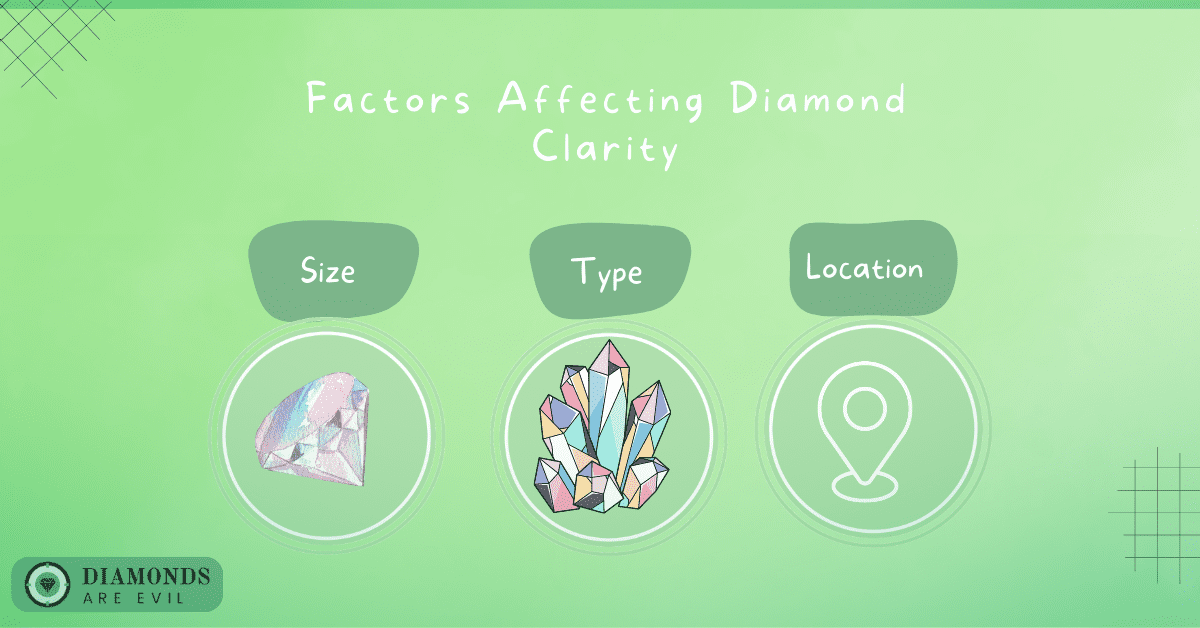
Size: Larger inclusions or blemishes can reduce a diamond’s clarity grade and visibility.
Location: Inclusions located in the center of the diamond can have a greater impact on its appearance than those located on the edges.
Type: The type of inclusion can affect the visibility of a diamond’s inclusions, with black or dark inclusions being more visible than white or transparent ones.
Diamond Treatments
Some treatments can minimize the appearance of inclusions, such as laser drilling or fracture filling.
Other treatments can affect a diamond’s clarity grade, such as HPHT treatment, which can create new inclusions or change the existing ones.
In conclusion, understanding the factors that affect diamond clarity is essential when selecting a diamond for your jewelry. It is important to consider the size, location, and type of inclusion, as well as any treatments that have been applied to the stone. By doing so, you can choose a diamond that meets your aesthetic and budgetary preferences while ensuring its quality and value.
Balancing Clarity with Other Factors
When selecting a diamond, clarity is just one of the factors to consider. It is essential to balance clarity with other factors such as carat weight and cut to find a diamond that meets your personal preferences and budget.
Carat weight refers to the size of the diamond and can also affect its price. A larger diamond with a lower clarity grade may still appear more impressive than a smaller diamond with a higher clarity grade. Therefore, it is essential to consider the balance between size and clarity to find the right diamond for you.
The cut of a diamond is also crucial as it determines its overall brilliance and sparkle. A well-cut diamond can enhance its appearance, making it appear brighter and more sparkly, even with inclusions. Therefore, a diamond with a lower clarity grade but a better cut may still appear more visually appealing than a higher clarity diamond with a poor cut.
Personal preferences and budget are also essential factors to consider when balancing clarity with other factors. Some individuals may prefer a larger diamond with lower clarity, while others may prioritize a higher clarity grade, even if it means a smaller diamond. Additionally, budgetary constraints can also play a role in the decision-making process, as diamonds with higher clarity grades tend to be more expensive.
When to Prioritize Diamond Clarity
While it is important to balance clarity with other factors when selecting a diamond, there are certain situations when prioritizing clarity is crucial.
For example, engagement rings are meant to last a lifetime, and therefore, it is essential to choose a diamond with the best possible clarity. A diamond with a higher clarity grade will be more durable and less likely to show signs of wear and tear over time, making it a more practical choice for an engagement ring.
Similarly, if you are investing in a diamond as a collectible or investment piece, a higher clarity grade will likely increase its value and rarity. Diamonds with higher clarity grades are less common and therefore more valuable. The rarity and beauty of a diamond with a higher clarity grade can make it an excellent investment piece.
When Clarity Isn’t as Important
When considering diamond jewelry, clarity is an essential factor to keep in mind. However, there are situations when it may not be as important. For instance, for earrings or pendants, inclusions may be less noticeable, allowing for other factors like cut and color to be prioritized. Similarly, for jewelry with multiple small diamonds, individual clarity may not be as crucial, and overall appearance may be prioritized.
The visibility of inclusions can also depend on the setting used. A diamond with a lower clarity grade may still look beautiful in certain settings, like a cluster or halo setting, where the surrounding smaller diamonds can mask the appearance of inclusions. It is important to balance all factors to find a diamond that is both visually appealing and fits your budget.
In conclusion
Diamond clarity is an important factor to consider when purchasing diamond jewelry, as it can affect the diamond’s appearance, value, and rarity. However, it is crucial to balance clarity with other factors, such as cut, color, and carat weight, as well as personal preferences and budget. There are also situations when clarity may not be as crucial, such as for earrings or pendants, or for jewelry with multiple small diamonds.
When making a purchase decision, it is highly recommended to consult with a reputable jeweler or gemologist who can provide expert guidance and help you choose a diamond that meets your needs and preferences. By understanding the various factors affecting diamond clarity and balancing them appropriately, you can find a beautiful and valuable diamond that you will treasure for years to come.