
The Impact of Diamond Quality on the Price of Jewelry
Diamonds are timeless symbols of love, beauty, and luxury. They are also highly sought-after commodities in the jewelry industry, where their quality can greatly influence the price of a given piece.
Knowing the importance of diamond quality when it comes to buying jewelry, as well as how different factors like cut, clarity, color, carat weight and other materials used can affect the price.
By understanding these factors, you will be able to make an informed decision when purchasing diamond jewelry that best suits your budget and preferences.
The Importance of Diamond Quality in the Jewelry Industry
Diamonds are one of the most sought-after gemstones in the world and are often used in the creation of high-end jewelry. However, not all diamonds are created equal, and the quality of a diamond can greatly impact the value and price of a piece of jewelry. Here are some reasons why diamond quality is important in the jewelry industry:
Affects the overall appearance of the jewelry piece: The quality of a diamond can greatly affect the overall appearance of a piece of jewelry. High-quality diamonds with excellent cut, color, and clarity can create a dazzling sparkle that enhances the beauty of the jewelry.
Determines the value and price of the jewelry: Diamonds are one of the most valuable gemstones in the world, and the quality of a diamond can greatly impact the value and price of a piece of jewelry. High-quality diamonds are rare and therefore more valuable, making them more expensive.
Influences customer satisfaction: Customers who purchase diamond jewelry expect high-quality diamonds that are dazzling and beautiful. If a diamond is of low quality, it may not meet the customer’s expectations, which can lead to dissatisfaction and negative reviews.
Reflects on the reputation of the jeweler: The quality of the diamonds used in a jewelry piece reflects on the reputation of the jeweler. Customers expect high-end jewelers to use high-quality diamonds, and if a jeweler uses low-quality diamonds, it may damage their reputation and credibility in the industry.
Ensures ethical and sustainable sourcing: High-quality diamonds often come from ethical and sustainable sources, which is becoming increasingly important to consumers. Jewelers who prioritize diamond quality also tend to prioritize ethical and sustainable sourcing, which can enhance their reputation and attract more customers.
An Overview of the Relationship Between Diamond Quality and Price
The quality of a diamond is one of the most important factors that influence its price. Diamonds are graded on the basis of the 4 Cs: cut, clarity, color, and carat weight. A high-quality diamond with excellent cut, clarity, and color is rare and therefore more valuable than a lower-quality diamond.
Carat weight also plays a role in the price, as larger diamonds are generally more expensive. However, the relationship between diamond quality and the price is not always straightforward, as there are other factors that can affect prices, such as brand reputation and design. Overall, the higher the quality of a diamond, the higher the price it will command in the jewelry market.
| Diamond Quality | Price Range (per carat) |
| Flawless (FL | $10,000 – $100,000 |
| Internally Flawless (IF) | $6,000 – $30,000 |
| Very, Very Slightly Included (VVS1-VVS2) | $4,000 – $10,000 |
| Very Slightly Included (VS1-VS2) | $2,500 – $6,000 |
| Slightly Included (SI1-SI2) | $1,000 – $3,000 |
| Included (I1-I3) | $500 – $1,500 |
Note: The above price ranges are for a one-carat diamond and are provided for general informational purposes only. Actual diamond prices can vary widely based on a variety of factors, including market demand, geographic location, and individual seller pricing strategies.
Factors Affecting Diamond Quality
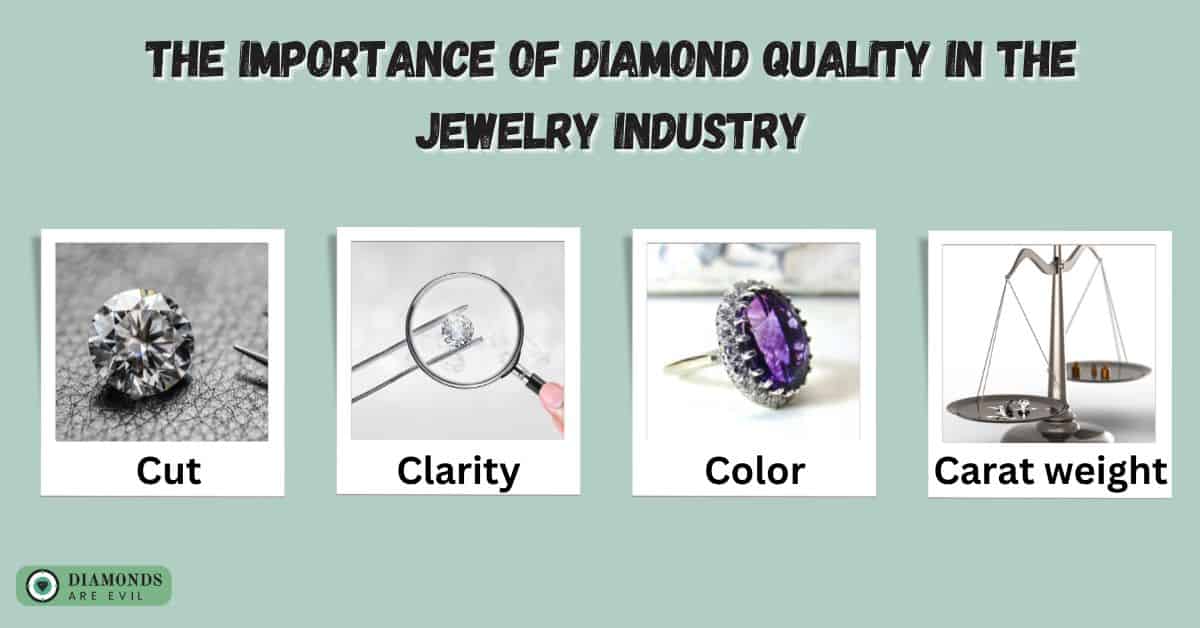
The 4Cs are the universal standard for grading and evaluating the quality of a diamond. Here is a detailed explanation of each of the 4Cs and how they affect diamond quality
Cut: The cut of a diamond refers to the proportions and angles of the stone. A well-cut diamond allows light to enter and reflect through the diamond in a way that maximizes its brilliance, fire, and scintillation. The GIA (Gemological Institute of America) rates cut on a scale from “Excellent” to “Poor”, with “Excellent” being the highest rating. A diamond with an excellent cut will have a symmetrical, well-proportioned shape that is highly valued in the jewelry market.
Clarity: Clarity refers to internal and external blemishes, or “inclusions”, and other imperfections that can affect the diamond’s overall appearance. Clarity is graded on a scale that ranges from “Flawless” (no inclusions or blemishes) to “Included” (numerous inclusions visible to the naked eye). The GIA also rates clarity on a scale from “IF” (internally flawless) to “I3” (included). The fewer the inclusions and blemishes, the higher the clarity grade and the more valuable the diamond.
Color: The color of a diamond refers to the presence or absence of color in the stone. The GIA color grading scale ranges from “D” (colorless) to “Z” (light yellow or brown). A completely colorless diamond is the most valuable and highly sought-after. Diamonds with more yellow or brown tint are less valuable, as they absorb light rather than refract it, resulting in a less desirable appearance.
Carat weight: Carat weight is the measurement of a diamond’s weight, with one carat equal to 0.2 grams. The larger the diamond, the more valuable it is, as larger diamonds are rarer and harder to come by. However, two diamonds of equal carat weight can vary greatly in value based on their cut, clarity, and color.
Overall, the quality of a diamond is determined by the combination of the 4Cs. A high-quality diamond will have excellent cut, high clarity, little to no color, and significant carat weight. Understanding the 4Cs is crucial for evaluating and valuing diamonds in the jewelry industry.
Note: The table provides a brief summary of each of the 4Cs and how they impact the quality and value of a diamond. The impact of each factor on diamond quality and value can vary depending on the specific diamond and its characteristics.
The Impact of Diamond Quality on Jewelry Price
Diamonds are one of the most sought-after gemstones, prized for their beauty and durability. However, not all diamonds are created equal, and the quality of a diamond can greatly impact its price. Here, we will explore the impact of diamond quality on the price of the jewelry.
High-quality diamonds command higher prices than low-quality diamonds
First and foremost, it’s important to note that high-quality diamonds generally cost higher prices than low-quality diamonds. The quality of a diamond is determined by four factors, known as the “4Cs”: carat weight, color, clarity, and cut. Each of these factors can significantly affect the value of a diamond.
How each of the 4Cs affects the diamond price
Here’s a table summarizing how each of the 4Cs (carat weight, color, clarity, and cut) affects the price of a diamond:
| Factor | Explanation | Impact on Price |
| Carat Weight | The size of the diamond | Generally, larger diamonds are more expensive |
| Color | The presence of any color in the diamond | Colorless diamonds are more valuable |
| Clarity | The presence of any imperfections in the diamond (inclusions) | Flawless diamonds are more valuable |
| Cut | The way the diamond has been cut and shaped | Well-cut diamonds reflect light in the most attractive way and are therefore more valuable |
How diamond quality affects the price of different types of jewelry
Here is a table providing examples of how diamond quality can affect the price of different types of jewelry:
| Type of Jewelry | Example | Impact of Diamond Quality on Price |
| Engagement Ring | 1-carat solitaire diamond engagement ring | A higher-quality diamond (e.g., higher carat weight, color, clarity, and cut) will generally result in a more expensive ring. |
| Tennis Bracelet | Diamond tennis bracelet with multiple diamonds | The total carat weight and quality of the diamonds will affect the price. A bracelet with higher-quality diamonds will be more expensive. |
| Stud Earrings | Diamond stud earrings with a single diamond in each earring | The size, color, clarity, and cut of the diamonds will affect the price. Earrings with higher-quality diamonds will be more expensive. |
| Necklace | Diamond pendant necklace with a single diamond | The size, color, clarity, and cut of the diamond will affect the price. A necklace with a higher-quality diamond will be more expensive. |
| Wedding Band | Diamond wedding band with multiple diamonds | The total carat weight and quality of the diamonds will affect the price. A wedding band with higher-quality diamonds will be more expensive. |
Note that these are just a few examples, and the impact of diamond quality on price can vary depending on many factors, including the design of the piece, the brand, and the market. However, in general, higher-quality diamonds will result in a more expensive piece of jewelry.
In conclusion
Diamond quality is one of the most important factors that influence the price of a piece of jewelry. High-quality diamonds with excellent cut, color, clarity, and carat weight can create a dazzling sparkle and command higher prices in the jewelry market.
Understanding the 4Cs and how they impact diamond quality is essential for determining the value of a diamond and evaluating different jewelry pieces. Knowing the impact of diamond quality on price can help both jewelers and consumers make informed decisions in selecting and purchasing diamond jewelry.