
The Process of Diamond Cutting and Polishing
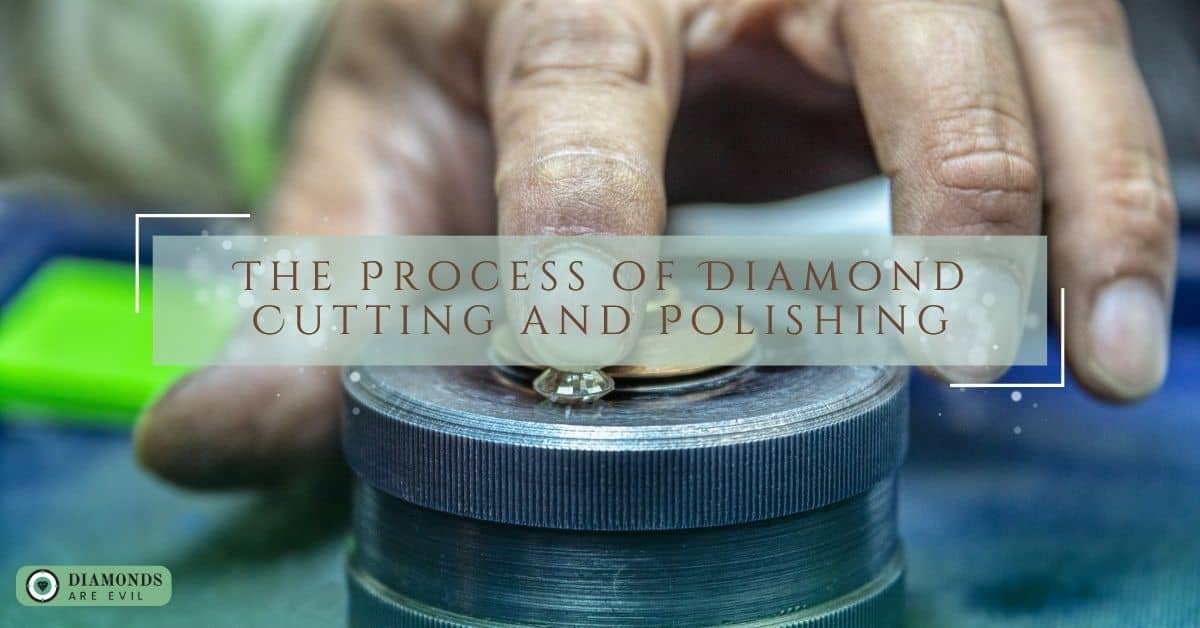
Diamonds are admired for their brilliance, sparkle, and beauty, making them one of the most sought-after gemstones in the world. Every diamond must go through a process of cutting and polishing before it can reach its full potential. By taking the necessary precautions and using modern innovations, diamonds can be safely cut and polished to bring out their maximum potential.
In this article, we will take an in-depth look at the process of diamond cutting and polishing, including its benefits, the steps involved, and modern innovations. We will also discuss some of the precautions that should be taken when cutting and polishing a diamond.
What is Diamond Cutting and Polishing
Diamond cutting and polishing is the process of transforming rough diamonds into sparkling gemstones that are suitable for use in jewelry. The process begins with the selection of a rough diamond, which is then cut and shaped into a specific size and shape, such as round, princess, or cushion. Once the diamond is cut and shaped, it is then polished to create a smooth, reflective surface.
The process of diamond cutting is done by a skilled diamond cutter, who uses specialized tools and equipment to make precise cuts and angles on the diamond’s surface. The cutter begins by marking and measuring the rough diamond to determine its size, shape, and quality. They then use a saw or laser to make an initial cut, which is called cleaving or sawing, and then they work on shaping the diamond into its desired shape using a process known as bruting or girdling.
In recent years, there have been many advancements in diamond cutting and polishing technology. Computer-aided design and cutting, laser cutting and polishing, and automation have all played a role in making the process more efficient and precise. These innovations have also allowed for new and unique diamond cuts and shapes to be created.
The Process of Diamond Cutting
The process of diamond cutting involves several steps that are used to transform rough diamonds into sparkling gemstones that are suitable for use in jewelry. The process begins with the selection of a rough diamond, which is then cut and shaped into a specific size and shape, such as round, princess, or cushion. Each step in the process is performed by a skilled diamond cutter who uses specialized tools and equipment to make precise cuts and angles on the diamond’s surface.
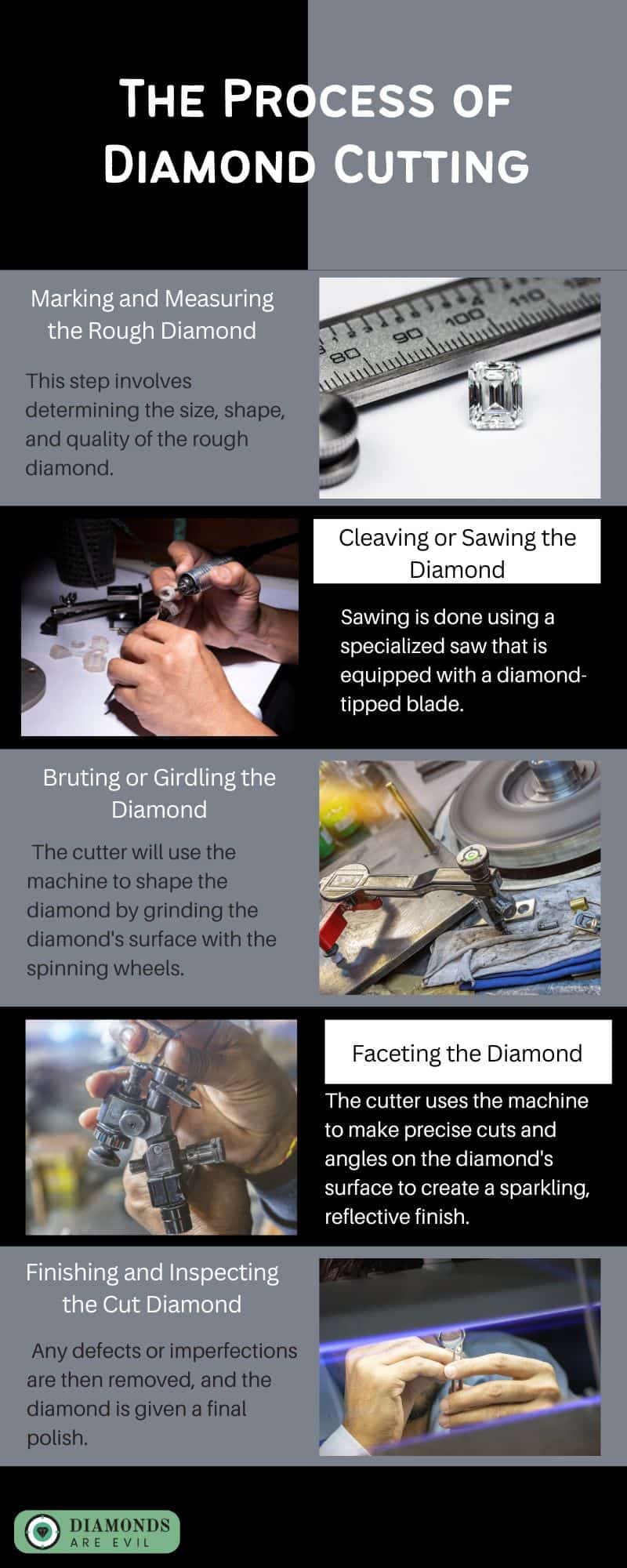
Marking and Measuring the Rough Diamond
The first step in the process of diamond cutting is marking and measuring the rough diamond. This step involves determining the size, shape, and quality of the rough diamond. The cutter will use a loupe, and a magnifying glass, to inspect the diamond for any inclusions, blemishes, or other imperfections. They will also measure the diamond to determine its size and shape.
Cleaving or Sawing the Diamond
The next step is cleaving or sawing the diamond, it is the process of separating the diamond into smaller pieces by making a precise cut along the diamond’s natural planes of weakness. Sawing is done using a specialized saw that is equipped with a diamond-tipped blade. The cutter will use the saw to make an initial cut, which is used to separate the rough diamond into smaller pieces.
Bruting or Girdling the Diamond
Bruting or girdling is the process of shaping the diamond into a round or oval shape. The cutter uses a bruting machine, which is equipped with two spinning wheels that are coated with diamond dust. The cutter will use the machine to shape the diamond by grinding the diamond’s surface with the spinning wheels.
Faceting the Diamond
Faceting is the next step in diamond cutting, it is the process of cutting and polishing the diamond’s surface to create a symmetrical shape with a smooth finish. This step is done by a skilled diamond cutter who uses a special tool called a faceting machine. The cutter uses the machine to make precise cuts and angles on the diamond’s surface to create a sparkling, reflective finish.
Finishing and Inspecting the Cut Diamond
After the diamond is cut and faceted, it is inspected for quality and accuracy. Any defects or imperfections are then removed, and the diamond is given a final polish. The end result is a sparkling, high-quality gemstone that is used in jewelry around the world.
After the diamond is cut and faceted, it is inspected for quality and accuracy. Any defects or imperfections are then removed, and the diamond is given a final polish. The end result is a sparkling, high-quality gemstone that is used in jewelry around the world.
Precautions to Take While Cutting and Polishing a Diamond
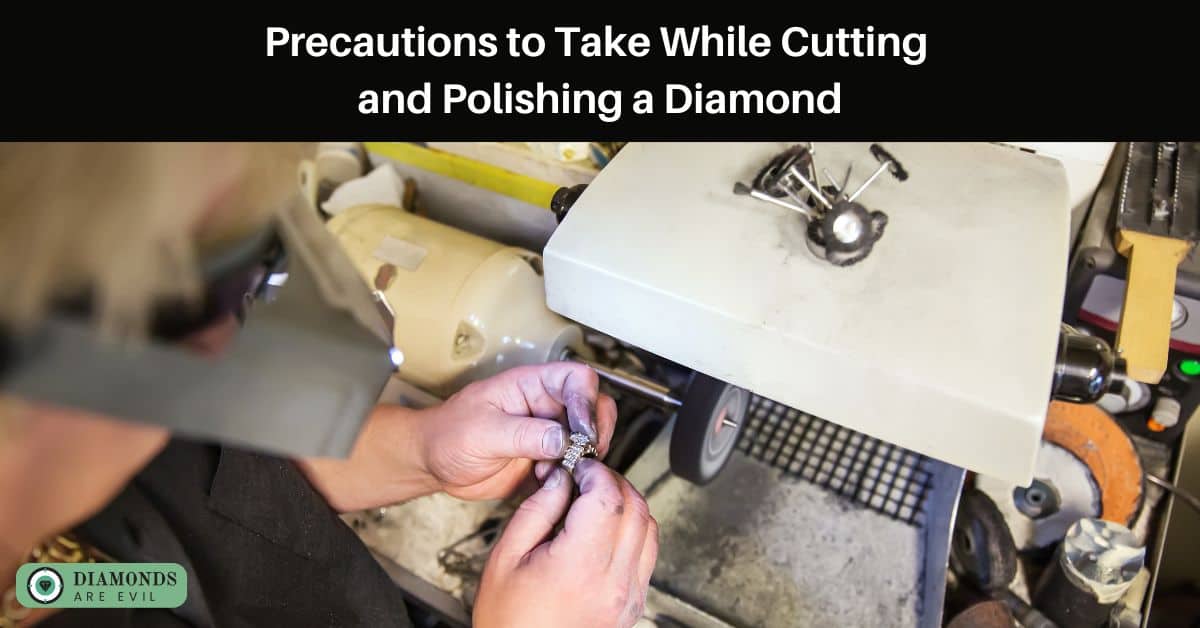
Diamond cutting and polishing is a highly skilled process that requires the use of specialized tools and equipment. It is important to take certain precautions to ensure the safety of the diamond cutter and the integrity of the diamond being cut and polished.
Wearing Appropriate Safety Gear
One of the most important precautions to take while cutting and polishing a diamond is to use proper protective gear. This includes safety glasses, gloves, and a dust mask to protect the cutter from the diamond dust that is created during the cutting and polishing process.
Use of Proper Tools and Equipment
Another important precaution is to use the proper tools and equipment. Diamond cutting and polishing require the use of specialized tools such as a faceting machine, a bruting machine, and a polishing wheel. It’s important to use the right tools to ensure that the cuts and angles on the diamond’s surface are precise and accurate.
It’s also important to use the right abrasive materials when polishing a diamond. Diamond dust is often used as an abrasive material, but it’s important to use the right grade of diamond dust to ensure that the diamond’s surface is polished to the desired level of smoothness.
Preventing Damage to the Diamond
Cutting and polishing diamonds is a delicate job because even the slightest misstep can cause irreparable damage. Taking the time to learn and practice proper safety precautions when cutting and polishing a diamond will help prevent unnecessary destruction of its exquisite shine and facets. Start by using clean, well-maintained equipment such as saw blades, needles, and cotton buffs.
Specialized lubricants must be applied to reduce friction which will lead to overheating of the diamond’s surface. Utilizing a microscope is ideal for magnifying the work so that you can focus with precision on the diamond’s edges, unable to miss unwanted blemishes or inclusions while grinding away any rough spots.
Modern Innovations in Diamond Cutting and Polishing
Diamond cutting and polishing is a highly skilled process that has undergone many changes and advancements in recent years. The use of modern technology has led to new and improved methods of cutting and polishing diamonds, making the process more efficient, precise, and cost-effective.
Computer-Aided Design and Cutting
One of the most significant innovations in diamond cutting and polishing is the use of computer-aided design (CAD) and cutting. This technology allows diamond cutters to create detailed 3D models of diamonds before they are cut, allowing them to make precise cuts and angles that are impossible to achieve by hand. This results in more precise cuts, better symmetry, and improved light performance in the finished diamond.
Laser Cutting and Polishing
Another modern innovation in diamond cutting and polishing is the use of laser cutting and polishing. Lasers can make precise cuts and polish diamonds with a high degree of accuracy, resulting in a higher quality diamond with fewer defects. This technology also allows for the cutting and polishing of diamonds with a greater degree of precision than traditional methods, which can result in diamonds that are more valuable due to their increased light performance.
Automation in Diamond Cutting and Polishing
Automation is also playing a big role in diamond cutting and polishing. This technology allows for the use of robotic arms and other automated equipment to perform tasks that were previously done by hand, such as marking and measuring, cutting, bruting, and faceting. This can improve the efficiency of the process, and also reduce the risk of human error.
In conclusion
Diamond cutting and polishing is a highly skilled process that requires specialized tools and equipment. By taking the necessary precautions and using modern innovations such as computer-aided design and cutting, laser cutting and polishing, and automation, diamonds can be safely cut and polished to bring out their maximum potential. With the right skills, knowledge, and tools, diamond cutters can create beautiful gemstones that will be admired for generations to come.