
Gold vs Diamonds: Which Is Best For Investment?

Investing in gold and diamonds is an age-old practice that has been around for centuries. Gold and diamonds are two of the most popular precious metals that people consider when making investment decisions. Both options have certain advantages, but there are also some drawbacks associated with each.
There is no clear answer to whether gold or diamonds are best for investment as it depends on individual goals and risk tolerance. Both have benefits and risks, and investors should carefully consider these factors before investing.
In this article, we will compare gold and diamond investments, exploring their rarity, historical value, performance in the market, cost of investing, liquidity, and accessibility, as well as risks and benefits. We’ll also discuss which one is best for investors.
Gold and Diamonds as Investment Options
In today’s uncertain economic climate, investing in gold and diamonds has provided many investors with a safe haven for their money. Gold is seen as a hedge against inflation due to its status as a safe haven asset, and its ability to maintain value during financial crises. Diamonds, on the other hand, are thought of as an attractive option for those looking for both stability and potential for appreciation in value.
Unlike stocks and bonds which may be more volatile in the short term, diamonds’ intrinsic relationships with supply and demand allow them to increase in value over time. For example, when the global economy is doing well, more people have money to invest and therefore more demand for diamonds exists. Conversely, when there is the less disposable income available then diamond prices weaken accordingly.

The Historical Value of Gold and Diamonds
Gold has been used as a currency and a store of value for centuries. Its rarity, durability, and malleability have made it a valuable commodity in various cultures throughout history. Gold was also used to back currencies, with the gold standard being a common monetary system until the mid-20th century. Today, gold remains a valuable investment option, providing a hedge against inflation and market volatility.
Similarly, diamonds have been highly valued throughout history for their rarity, beauty, and durability. Diamonds were first mined in India over 2,000 years ago and were highly prized by royalty and wealthy individuals. Today, diamonds continue to be valued for their historical significance, as well as their rarity and beauty.

The Performance of Gold and Diamonds in the Market
The performance of gold and diamonds in the market can be influenced by various factors, including supply and demand, geopolitical events, and economic conditions.
Gold is often considered a safe-haven asset and tends to perform well during times of economic uncertainty or market volatility. It has a track record of holding its value over time and can provide a hedge against inflation. However, the price of gold can be affected by changes in interest rates and the strength of the US dollar, as well as fluctuations in global demand.
Diamonds, on the other hand, are not as easily traded as gold and have a less liquid market. Their value is determined by the four Cs, and the rarity and quality of a particular diamond can greatly influence its price. However, investing in diamonds carries risks, such as the possibility of investing in fake or artificially inflated diamonds.

The Cost of Investing in Gold and Diamonds
The cost of investing in gold and diamonds can vary depending on various factors, including the form of the investment, the quality of the asset, and the associated fees and expenses.
Investing in gold can be done in various forms, such as purchasing physical gold bars or coins, investing in gold ETFs, or trading gold futures contracts. Each form of investment can have associated costs, such as storage fees for physical gold or management fees for ETFs.
Similarly, investing in diamonds can also come with associated costs, such as appraisal and certification fees, insurance, and storage fees.
Furthermore, the quality of the asset can also impact the cost of investing. Higher-quality diamonds or gold can command higher prices, while lower-quality assets may be more affordable.
Investors should carefully consider the costs associated with investing in gold and diamonds before making a decision. It is important to factor in any fees or expenses, as well as the potential for fluctuation in the value of the asset.

Liquidity and Accessibility
Liquidity and accessibility are important considerations for investors looking to invest in alternative assets such as gold and diamonds.
Gold is a highly liquid asset, with a global market that is open 24 hours a day, seven days a week. This means that gold can be easily bought and sold at any time, and its value is widely recognized and accepted around the world.
Diamonds, on the other hand, have a less liquid market, and their value can be more difficult to determine. While diamonds can be bought and sold through dealers and auctions, the market is not as easily accessible as the gold market, and it can be more challenging to find buyers or sellers.
In addition to liquidity, accessibility is also an important consideration for investors. Gold can be easily bought and sold through a variety of channels, such as banks, online marketplaces, and dealers. This accessibility makes it an attractive investment option for both individual and institutional investors.
Diamonds, however, can be more challenging to access, particularly for individual investors. The high cost and specialized knowledge required to invest in diamonds can make it more difficult for individual investors to enter the market.

Risks and Benefits of Investing in Gold and Diamonds
Investing in gold and diamonds can provide diversification and potential appreciation in value, but it also comes with risks. Here is a list of some of the risks and benefits of investing in gold and diamonds:
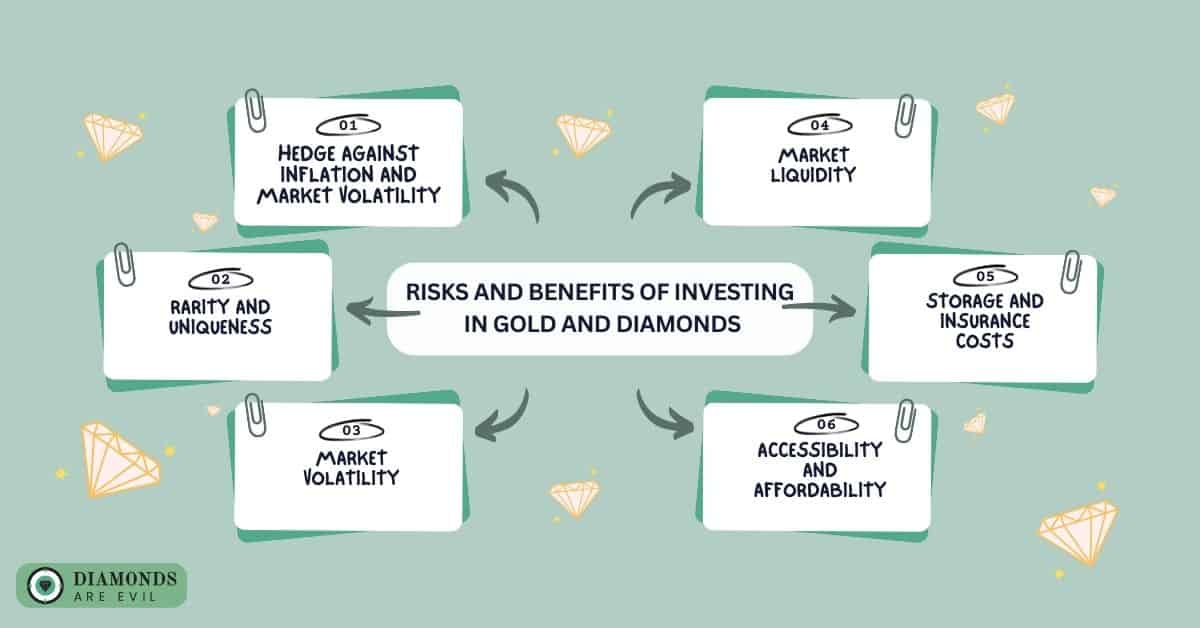
Hedge against inflation and market volatility: Both gold and diamonds have a history of holding their value over time, making them a potential hedge against inflation and market volatility.
Rarity and uniqueness: Gold and diamonds are considered luxury items and can appreciate in value due to factors such as quality, rarity, and demand.
Market volatility: The price of gold and diamonds can be influenced by various factors, including changes in supply and demand, geopolitical events, and economic conditions.
Market liquidity: The market for diamonds is less liquid than the market for gold, making it more challenging to sell the asset quickly.
Storage and insurance costs: Investing in physical gold and diamonds requires storage and insurance, which can add to the cost of the investment.
Accessibility and affordability: Gold is a more accessible and affordable investment option compared to diamonds, which can be more challenging for individual investors to access.
In conclusion
Both gold and diamonds have their own unique advantages and can be beneficial investments for those looking to diversify their portfolios. Investing in gold may provide protection against inflation and market volatility, while investing in diamonds may offer the potential of appreciation in value due to factors such as quality and rarity.
However, investors should carefully consider the various risks and benefits before making a decision, including the costs associated with investing in gold and diamonds, their liquidity, accessibility, and potential for fraud. Ultimately, investors should look at their individual investment goals and risk tolerance when deciding whether gold or diamonds are best suited to their needs.